Boiler Feed Pump Cavitation Diagnostics: NPSH Margins & Troubleshooting
Reliability Engineering Overview
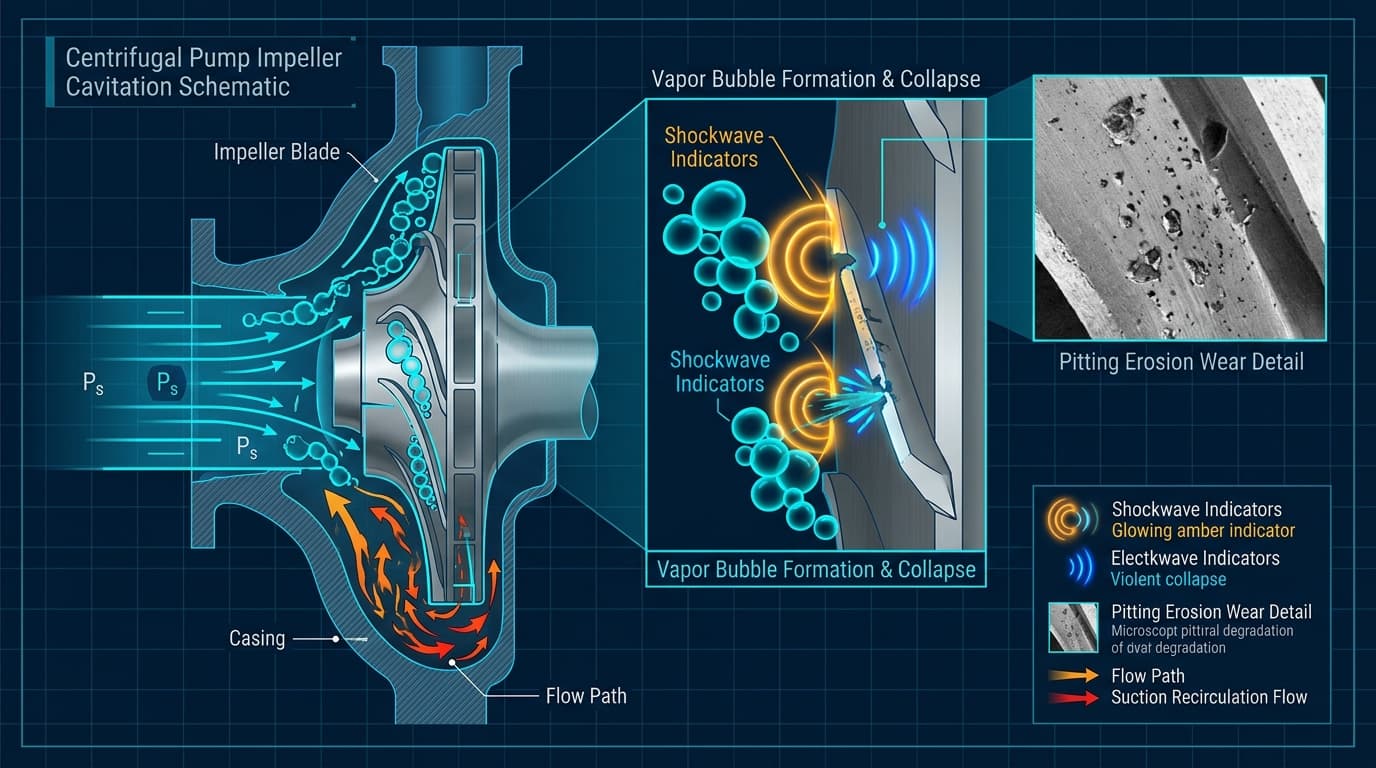
Boiler feed pump cavitation is not merely a hydraulic annoyance—it is a leading cause of catastrophic forced plant outages. The violent micro-jet collapse of vapor cavities generates localized mechanical stresses exceeding 1,000 MPa, destroying 13% chrome and duplex stainless steel impellers, wiping out mechanical seal faces, and destabilizing high-pressure balancing drums. This guide outlines root causes, acoustic vibration patterns, and engineering remediations.
01.Differentiating the Two Major Forms of Cavitation
In boiler feedwater systems, cavitation manifests in two distinct fluid dynamic mechanisms that occur at opposing ends of the pump performance curve:
1. Classical Vaporization Cavitation (High Flow)
Occurs when total suction pressure drops below liquid saturation vapor pressure (NPSHa < NPSHr). Characterized by vapor sheet formation on the low-pressure (suction) side of the blade leading edge.
- Trigger: High throughput, clogged suction strainer, low deaerator level.
- Damage Zone: Hidden suction side of impeller vanes.
- Acoustic Profile: High-frequency broadband hiss (> 5 kHz) or gravel sound.
2. Suction Recirculation Cavitation (Low Flow)
Occurs when the pump operates below its Minimum Continuous Stable Flow (MCSF). High incidence blade angles cause fluid boundary layers to detach, creating reverse rotational vortex eddies at the impeller eye inlet.
- Trigger: Throttled boiler operation without open bypass valve.
- Damage Zone: Pressure (drive) face of vanes and inlet casing shroud.
- Acoustic Profile: Deep low-frequency surging (0.1× to 0.8× running speed).
02.The Deaerator Pressure Decay Transient
In steam power plants, the most severe cavitation episodes occur during sudden steam turbine load drops or emergency boiler runbacks. The thermodynamic sequence unfolds in seconds:
- Turbine extraction non-return valves slam shut; heating steam to the deaerator drops to zero.
- Cold condensate makeup continues to enter the vessel, causing deaerator vapor pressure to collapse abruptly.
- Water within the deaerator vessel cools rapidly; however, the water column trapped inside the vertical suction downcomer line remains hot at the pre-trip temperature.
- Static pressure at the pump inlet drops instantaneously, but fluid vapor pressure remains high. Instantaneous vapor flashing occurs throughout the suction line, air-binding the pump.
Engineering Countermeasures for Pressure Decay:
- Minimize suction downcomer volume to decrease transit lag time (< 15 seconds at rated flow).
- Incorporate automated auxiliary live steam pegging valves to maintain minimum deaerator vessel pressure during trips.
- Design static suction elevation (Z_suction) with an additional 1.5 to 2.5 meters of transient safety margin.
03.Field Diagnostic & Troubleshooting Matrix
| Observed Field Symptom | Probable Hydraulic Root Cause | Recommended Engineering Action |
|---|---|---|
| Gravel noise at high steaming rates | Classical NPSHa deficiency (NPSHa < NPSHr) | Inspect suction strainer differential pressure; elevate deaerator level; verify suction block valves are 100% back-seated. |
| Pulsating casing vibration at low boiler load | Internal suction recirculation (Flow < MCSF) | Verify minimum flow recirculation valve (ARV) opens fully; trim impeller eye diameter or install flow inducer. |
| Sudden motor amp fluctuations & head loss | Vapor binding / deaerator pressure decay transient | Check deaerator steam pegging regulator; purge trapped vapor from casing top vent valves. |
| High 1X RPM axial vibration | Impeller mass unbalance caused by cavitation pit erosion | Perform borescopic inspection; re-balance rotor; upgrade first-stage impeller metallurgy to CA6NM or Super Duplex. |
04.The Role of Automatic Recirculation Valves (ARVs)
Every high-pressure boiler feed pump must be protected by an Automatic Recirculation Valve (ARV) or a modulating minimum flow control loop. Without continuous minimum flow:
At low flows where efficiency drops below 15%, all input shaft horsepower converts into fluid thermal energy. Fluid temperature spikes within 10 to 30 seconds, causing vapor flashing across the balancing drum and total mechanical seizure.
- Standard MCSF Setting: Typically 25% to 35% of Best Efficiency Point (BEP) flow.
- Recirculation Destination: Must always discharge back to the deaerator storage tank above the water line, never directly to pump suction, to permit thermal dissipation.
Verify Your System's NPSHa Cavitation Margins Online
Calculate exact suction line friction, static head elevation, and safety ratios using the Zolvia engineering calculation suite.
Frequently Asked Questions: Cavitation & NPSH
What does boiler feed pump cavitation sound like in the field?
Classical vaporization cavitation produces a distinctive, loud rattling sound often described as "pumping rocks or gravel" through the casing. In contrast, low-flow suction recirculation generates deep, low-frequency surging and knocking vibrations that peak at vane pass frequency.
What is the difference between classical vaporization cavitation and suction recirculation?
Classical vaporization cavitation occurs at high flow rates when Net Positive Suction Head Available (NPSHa) falls below NPSH required (NPSHr), causing vapor bubbles in the impeller eye that collapse on the low-pressure side of the blade. Suction recirculation occurs at low flow rates (below MCSF) when high incidence angles cause fluid to reverse direction at the impeller inlet tips, creating high-energy shear eddies that pit the pressure side of the blade.
Why is NPSHr defined as a 3% head drop (NPSH 3%) insufficient for boiler feed service?
The international standard definition of NPSHr (ISO 9906 / ANSI/HI 1.6) is the point where cavitation is already so severe that the total pump head drops by 3%. Long before a 3% head reduction occurs (NPSH incipient), localized micro-cavitation bubble collapse is already actively eroding impellers. For high-energy feed pumps, a safety margin ratio of 1.5 to 2.0 × NPSH 3% is required.
How does a transient turbine trip or deaerator pressure drop trigger sudden cavitation?
When steam turbine load drops suddenly, cold makeup water floods the deaerator while extraction heating steam cuts off. The vessel pressure drops rapidly. However, the hot water column inside the downcomer suction pipe remains at the previous higher saturation temperature. Static pressure in the suction line drops faster than water temperature can cool, causing spontaneous flashing in the pipe and instant pump vapor lock.